



Turkey's unit of currency is the Turkish Lira (Türk Lirası), abbreviated TL, TRY, or using the special Turkish lira symbol (₺). Here's the full story...
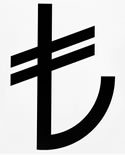 |
| Turkish Lira symbol |
Here are current Turkish Lira exchange rates.
Old Liras, New Liras
From 2005 through 2008, the Turkish currency was called th New Turkish Lira (Yeni Türk Lirası, YTL or TRY).
In 2009 a new series of banknotes(bills) called "E9," with strengthened anti-counterfeiting features, was introduced.
Both the 2005 series notes and 2009 "E9" series notes had the same value, but the older YTL/TRY banknotes were withdrawn from circulation during 2009.
As of December 31, 2009, the 2005 New Turkish Lira (YTL) notes are no longer accepted for payment, but may be exchanged for the newer 2009-series Turkish Lira notes at any branch of the Central Bank of the Republic of Turkey (TC Merkez Bankası), or TC Ziraat Bankası.
The current Turkish Lira is equivalent to one million (old, pre-2005) Turkish Liras (TL). In other words, six zeros were dropped from the old TL in 2005 to make the YTL, which is now—again—called simply "TL."
Old pre-2005 Turkish Liras
The YTL replaced the old pre-2005 Türk Lirası (TL, TRL). Old Turkish liras were withdrawn from circulationduring 2005.
Note that you should not accept pre-2005 Turkish Lira notes —the ones with lots of zeros—any more. They are no longer legal for payment. That old 1 million TL note won't even buy you a cup of Turkish coffee.
Old TL notes may now be exchanged for 2009 TLs only at Turkish Central Bank (TC Merkez Bankası) offices or, in the absence of a Central Bank office, at a TC Ziraat Bankası office, until December 31, 2016.
LeftoverCurrency.com says it will buy these old notes from you. More...
Cash4Coins.co.uk will exchange your leftover Turkish lira coins and notes for GBP (UK pounds sterling) by mail. More...
After December 31, 2016, old TL notes and coins will no longer be legal tender (ie, official currency). In other words, they will be worthless except for their curiosity or collectors' value.

Until 2005, you had to deal with all those zeros.
With the 2009-series Turkish Lira, it's much simpler now.
Counterfeit Turkish Lira Notes
Besides out-of-date Turkish lira notes, you may encounter counterfeit Turkish lira notes, as well as fake US dollar and euro notes. Here's how to recognize. them. More...
| Turkish Central Bank |









 Best Travel Agencies
