


The Galata Mevlevihanesi, or tekke (TEHK-keh), is a Mevlevi Whirling Dervish hall on Galipdede Caddesi just south of Tünel Square, at the southern end of Beyoğlu's İstiklal Caddesi in Istanbul (map).
They still whirl here on an irregular schedule, with different groups doing the whirling on different dates, but usually starting at 17:00 (5:00 pm). To be sure of getting tickets, stop by the museum in advance to determine the exact time, and when you can buy a ticket (TL50).
You have other opportunities to see the dervishes whirl in Istanbul, however. Here they are.

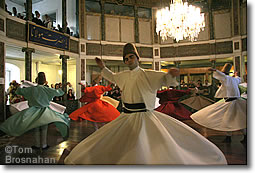
Mevlevi dervishes whirl during the sema in the Galata Mevlevihanesi.
About the Galata Mevlevihanesi
The Galata tekke has a long and revered history, having been founded in 1491 by a Ottoman grandee from the palace of Sultan Beyazit II. The tekke's first şeyh(sheikh, leader) was Muhammed Semaî Sultan Divanî, a descendant of Mevlâna Jelaleddin Rumî himself.
The building you see is not the original, which burned in 1765, but its replacement, which dates from 1796 and was extensively restored during the 19th century, also between 1967 and 1972, and again in 2008. (Here's another photo.)
The Galata Mevlevihanesi Müzesi is open daily except Monday from 09:00am to 16:30 (4:30pm), with last entry at 16:00 (4pm). There is a small admission fee.
Galip Dede, a renowned 17th-century sheikh of this tekke, is buried in an ornate tomb to the left as you enter from the street.
Kumbaracıbaşı Ahmet Paşa, better known in the west as Claude Alexandre, Comte de Bonneval (1675-1747), a French nobleman who converted to Islam and entered the sultan's service as a bombardier general, is also buried on the tekke's grounds.
Nearby is the tomb of İbrahim Müteferrika (1674-1745), an ethnic Hungarian Unitarian from Transylvania who converted to Islam and established the first Arabic/Ottoman moveable-type printing press in the Ottoman Empire in the 1720s.
—by Tom Brosnahan


 Request Transportation
