


Here's an excerpt from my humorous travel memoir,Bright Sun, Strong Tea. (The previous episode is Champagne in the Air.)
I returned to Istanbul, but I spent little time in my apartment. Istanbul to me was the Hippodrome, the historic center of the old city.
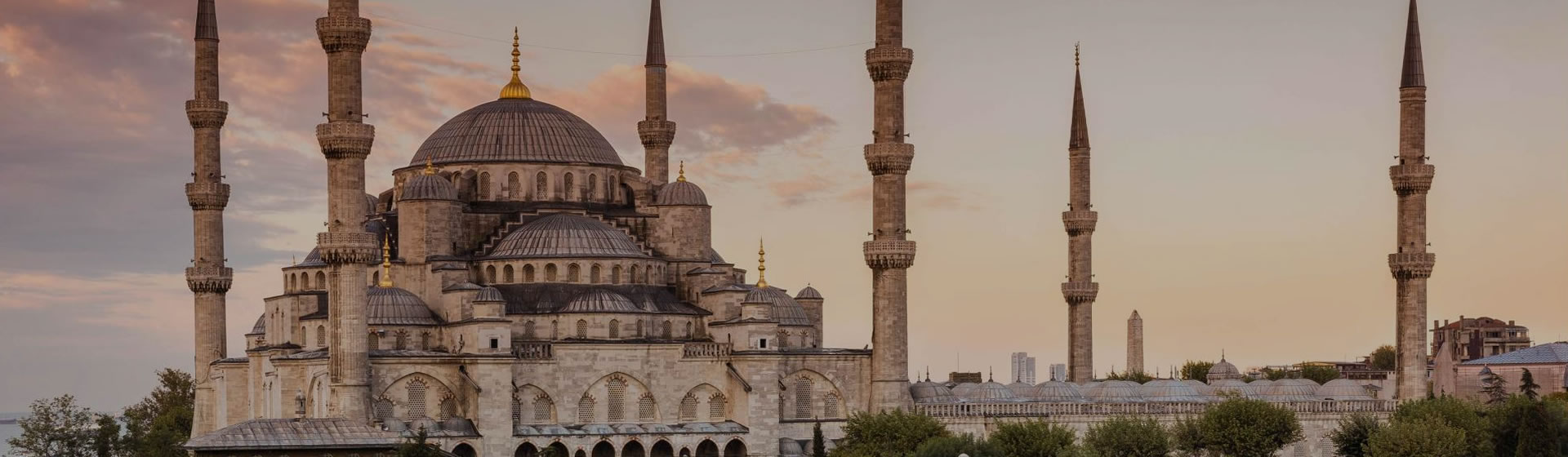
I stopped in at the Blue Mosque, as I still do, just to sit for a few minutes in its sacred quietness.
The Mosque of Sultan Ahmet I (built 1606-1616) contains a visual tip-of-the-hat from its architect, Sedefkar Mehmet Aga, to the architects of Ayasofya (Hagia Sophia) who worked their miracle a thousand years earlier.
Few people realize this among the crowds of tourists who enter it once in their lives to marvel at its grandeur, or among the crowds of locals who pray there every day. I think of it as the Magic of the Blue Mosque.
I discovered the Magic, Mehmet Aga's salute to Anthemius of Tralles and Isidorus of Miletus, one day as I approached the mosque from the Hippodrome, walking slowly through the gate in the outer wall, complete with its hanging chains that forced horsemen to dismount when entering the holy precinct. I looked ahead and my eye rose up the broad staircase and penetrated the tall portal of the mosque courtyard. Through the portal in the center of the courtyard was the domed sadirvan (ablutions fountain). Above its dome rose another dome, the one atop the main portal into the mosque sanctuary. I approached the steps and climbed them slowly, looking ahead, watching in amazement as dome after dome appeared above the two I had already noticed. A cascade of domes and semi-domes billowed heavenward until the mosque's great dome appeared triumphantly above all.
As I entered the courtyard the two slender minarets flanking the mosque shot heavenward insistently: Up! Look up!
The two great buildings, Ayasofya and the Blue Mosque, stand beside one another on the Hippodrome, separated only by a small park. They are both entered from the same direction. In one, the visitor's eye is lifted heavenward inside, in the other, on the outside: master architects conversing across a millennium.
I walked across the courtyard and approached the west door of the mosque, which was reserved for Muslims (tourists used the north door). An old man smiled and pointed toward the north door, but I said a few words in Turkish and he chuckled an excuse-me-I-didn't-know-you-were-a-Turk. (At that time it was accepted without question that no foreigner spoke Turkish, so I must be a Turk.)
It was not prayer time, so there were only a few people in the mosque performing their "catch-up" prayers for ones they had missed earlier. I carefully avoided walking in front of them. I had been taught that the strictest Muslims didn't like anyone walking in front of them at prayer because it might be misinterpreted that they were praying to the person in front of them instead of to God.
I found a quiet place near one of the massive marble pillars and sat down in the traditional position, legs folded beneath me. I closed my eyes and listened to the stillness, the soft padding of stockinged feet on rich carpets, hushed movement and rustle of garments as a few men performed their ritual genuflexions. God-rays, colored by the stained glass windows above the mihrab (prayer niche), pierced the still air, illuminated floating motes of dust, then blazed on the floor.
After a few minutes I was conscious of someone approaching and sitting down near me. The mosque was nearly empty, so he must have approached on purpose. I looked his way. He nodded. I nodded back.
"Merhaba," he said.
"Merhaba."
He was young and relatively tall, with black hair and moustache, and a smiling, open face.
"You speak Turkish," he said in Turkish, half as an exclamation, half as a question.
The old man must have told him.
"Are you a Turk? Where are you from?"
"America."
"America! And you speak Turkish? Amazing!" he said. "Good for you!"
He was carrying the sort of big leather open-mouthed satchel that mailmen carry all over the world.
"You're a mailman?" I asked.
"Yes, yes. Are you a tourist? A soldier?" These were the two most likely possibilities.
"No, I'm a teacher," I said, choosing not to get involved in I'm-writing-a-guidebook-but-I've-just-started, etc. "I've been teaching at a school in Izmir."
"Very good! You have come to teach us? Very good!"
We sat in silence for a moment, enjoying the peace and vastness of the holy space.
"Uh,...." Pause. "Are you a Christian?" he asked hesitantly, approaching the topic as delicately as possible. He was embarrassed, and I was embarrassed by his embarrassment, by his having raised one of the three topics—politics, sex, religion—which must be approached delicately anywhere in the world. He might as well have asked "Was that fart yours?"
Now, any young person out in the world searching for the meaning of life is liable to have complicated religious loyalties, but it was easiest to give him the answer he expected, which was... "Yes."
"Good, good." Pause. "Yes, Christianity. It is good. Judaism, too. All good." Pause. He pondered his strategy.
"Do you know that the Prophet Abraham and the Prophet Jesus are sacred to Muslims? Mary, too. And Saint Peter. And Saint Paul. And the Jewish saints and lots of other saints. Of course the Prophet Muhammed is the last and greatest of the prophets. We have lots of saints in Islam, Muslim saints. We revere the Bible. It is a holy book, like the Holy Kur'an. And the Torah too. It is holy. But the Kur'an is the final book, the best of all."
He paused, gathering strength for The Pitch.
"Have you ever considered becoming a Muslim? It would be good. We would welcome you."
I was touched!
...
I looked at the mailman. Careful, careful....
"Thanks. I'll think it over, but at the moment I'm fine being what I am."
"Yes! Fine!" he said. "Yes, of course! I just wanted you to know about Islam. Perhaps you will think it over, and you will see. Judaism came first, then Christianity, and finally Islam, the last and best.
"All the good things in those earlier religions are in Islam. Think about it: we have all your saints...and more!"
A quantitative approach to faith!
We shook hands. He got to his feet.
"Enjoy your stay in Turkey," he said, smiling. "Thank you for coming to teach us. I wish you all the best."
He walked away to a quiet spot, raised his hands in supplication to heaven, and began his prayers.
Click here to order an autographed copy of the book online with credit card or PayPal.
(Excerpts from Turkey: Bright Sun, Strong Tea copyright © 2004 by Tom Brosnahan. All rights reserved.)
(Next: The Blonde at the Circumcision Party)
| More Excerpts from Bright Sun, Strong Tea |

 Best Travel Agencies
